Xiaomi Releases MiMo-V2.6: Open-Source Omnimodal Models and Scaled RL

On September 22, 2026, Xiaomi released and open-sourced the MiMo-V2.6 series. The release marks a key milestone in recursive self-improvement (RSI): scaling reinforcement learning (RL) on verifiable, complex tasks, allowing models to expand their capability frontier through autonomous exploration and verification.
The family features two natively omnimodal models: MiMo-V2.6-Pro, Xiaomi's most capable foundation model to date, and MiMo-V2.6-Flash, tuned for efficiency and low latency. The release also includes MiMo-V2.6-Pro-UltraSpeed, delivering up to 20x faster token throughput while preserving full answer quality.
Pareto Frontier and Benchmark Standing
In the Artificial Analysis Intelligence Index v4.3, MiMo-V2.6-Pro achieved a score of 46.32. This represents the top score among open-source models globally, outperforming Kimi K3 and Qwen3.8 Max.
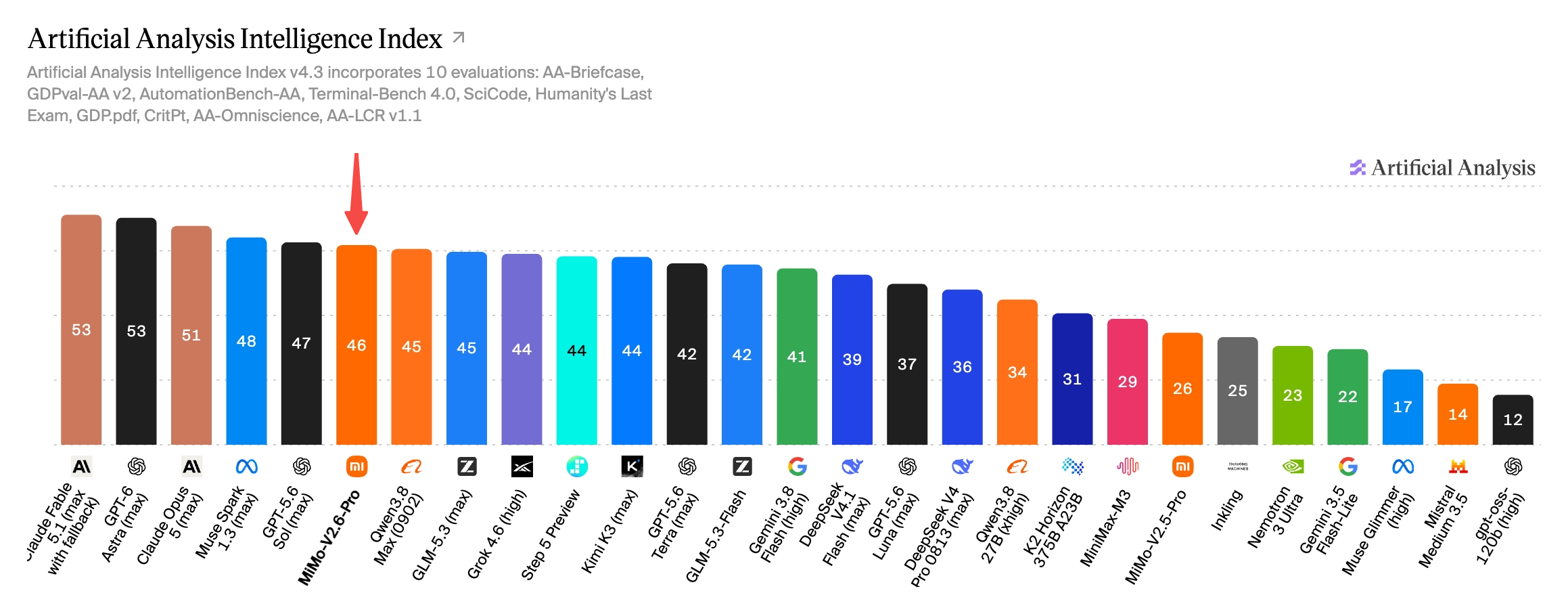
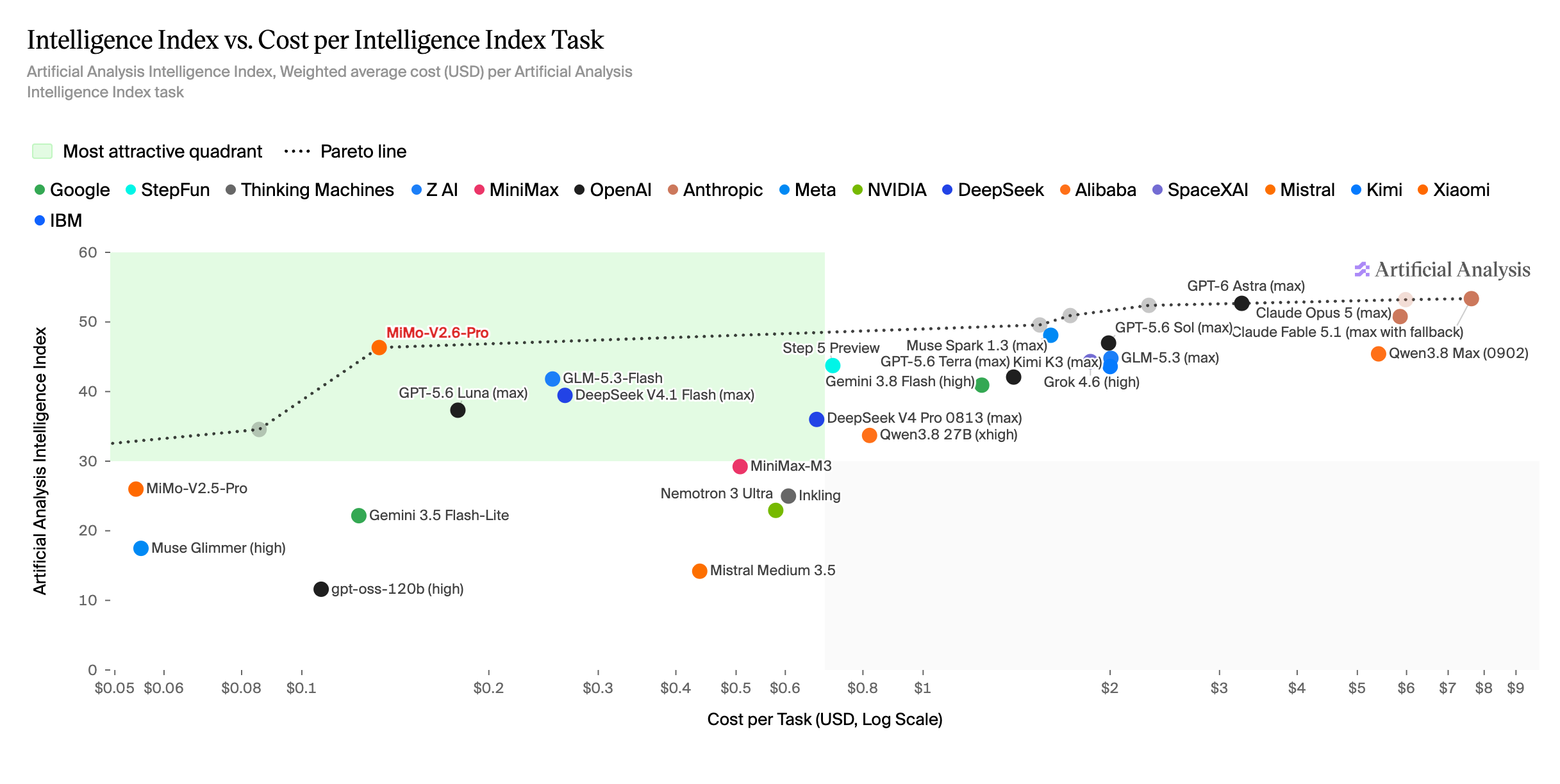
Open-Source Reinforcement Learning at Scale
Xiaomi livestreamed the entire production RL training run. In under six days, MiMo-V2.6-Flash and MiMo-V2.6-Pro completed 30 RL steps across roughly 750,000 trajectories.
Average pass rates across the training suite grew by 25% for Flash and 12% for Pro. On DeepSWE v1.1, a held-out software engineering evaluation, scores jumped by 17 points (48.8 to 65.68) on Flash and 14 points (58.4 to 72.57) on Pro.
Training compute was scaled along three technical axes:
- Asynchronous architecture with large batches: 1,568 samples per parameter update, context lengths up to 1 million tokens, and 3.5 to 3.7 billion tokens per step.
- Heterogeneous task environments: a multi-task suite spanning software engineering, autonomous tool-use agents, visual user interfaces, and cybersecurity scenarios.
- Grader-side compute: relative group comparisons provide precise reward signals across long reasoning horizons, guiding models toward shorter execution trajectories and lower token consumption.
To maintain optimization stability, the routing network was frozen during training, paired with multi-layer defenses against reward hacking (adversarial probing, anomaly detection, and cross-verifier validation). The full technical report, RL code, and evaluation environments are publicly available on HuggingFace and GitHub.
From Code Generation to Interactive Environments (Vibe World)
MiMo-V2.6 brings together 3D spatial reasoning, omnimodal perception, and Computer-Use Agent (CUA) capabilities. Natural language prompts now translate beyond software code into complete interactive simulations, procedural 3D assets, and physical robotics controls.
3D Game Development
From a text prompt or reference image, MiMo-V2.6 decomposes goals into discrete tasks, coordinates specialized subagents to construct 3D scenes, implements game logic, and verifies visual fidelity against real-time renders.
Procedural 3D Modeling in Blender
The model generates 3D geometries and spatial assets in Blender from text prompts or single reference images, exporting ready-to-use models for game engines, animation pipelines, and 3D printing.
Robotics and Sensor-Driven Simulation
Inside physics simulation environments, MiMo-V2.6 ingests multi-camera feeds, processes visual observations in real time, and operates a Franka Panda robotic arm via closed-loop feedback to grasp items, sort objects by color, and position components.
Visual Design and Video Production
MiMo-V2.6 builds full web interfaces and structured slide presentations with layouts, responsive animations, and functional components. The model connects with Figma, styling typography, palettes, and visual hierarchy to maintain consistent UI aesthetics.
For video synthesis, MiMo-V2.6 manages scriptwriting, storyboard staging, motion sequencing, background music composition, and beat-synchronized cuts. For technical explainers, abstract mathematical topics like Fourier decomposition are translated into intuitive animations paired with synchronized voiceover generated by MiMo-V2.5-TTS.
Music Composition
MiMo-V2.6 integrates musical theory, harmonic progression, and instrumentation modeling. It composes standalone pieces and exports structured MIDI files.
When prompted to compose an orchestral score for ten instruments (strings, oboe, clarinet, trumpet, trombone, French horn, glockenspiel, and timpani), MiMo-V2.6-Pro drafted the full arrangement and compiled it into MIDI.
Xiaomi also released two solo piano compositions in A minor demonstrating dynamic control, tempo phrasing, and textural depth:
Scientific Research and Formal Proof Verification
Without task-specific post-training for scientific domains, MiMo-V2.6 demonstrated practical problem-solving across two research case studies:
- Materials Engineering: Xiaomi materials researchers tasked the model with designing a zirconium-based metal-organic framework (UiO-67 MOF) for filtering per- and polyfluoroalkyl substances (PFASs). MiMo-V2.6-Pro executed literature searches, evaluated patent novelty, configured simulation software, and calculated binding affinities between MOF pores and target PFAS molecules, producing candidate structures ready for wet-lab validation.
- Mathematical Formalization in Lean 4: MiMo-V2.6-Pro assisted mathematicians in formalizing the main theorem from Li and Yorke's classic 1975 paper, "Period Three Implies Chaos". Collaborating subagents drafted lemma statements and deductive steps, culminating in over 6,000 lines of verified Lean 4 code with zero unresolved
sorryplaceholders. The complete project was released publicly alongside the model.
Benchmark Evaluation Results
| Domain | Benchmark | MiMo-V2.6-Pro | MiMo-V2.6-Flash | MiMo-V2.5-Pro | DeepSeek V4.1 Flash | Claude Opus 5 |
|---|---|---|---|---|---|---|
| Coding | DeepSWE v1.1 | 71.9 | 67.9 | 19.0 | 74.2 | 74.0 |
| Coding | ProgramBench | 26.5 | 26.0 | 12.5 | 20.3 | 37.0 |
| Coding | MiMo Code Bench | 63.2 | 61.2 | 40.4 | 60.2 | 68.6 |
| General Agents | GDPVal 2.1 (AA Elo) | 1673 | - | 1107 | 1600 | 1708 |
| General Agents | Toolathlon-verified | 76.9 | 73.6 | 49.1 | - | 80.6 |
| General Agents | Automation Bench v1.0.6 | 53.1 | 52.3 | 16.0 | 54.8 | 50.3 |
| General Agents | Agents' Last Exam | 31.6 | 27.6 | 13.2 | 31.8 | 31.6 |
| Visual Coding | MiMo Visual Coding | 72.3 | 71.5 | - | 70.6 | 70.0 |
| Cybersecurity | CyberGym | 94.0 | 95.1 | 40.0 | 88.1 | - |
Availability
The MiMo-V2.6 model family is accessible across multiple interfaces and developer platforms:
- Web platforms: Xiaomi AI Studio and MiMo Code.
- Desktop: MiMo Desktop version 1.0 with support for UltraSpeed inference mode.
- Developers: the Xiaomi MiMo API Platform, OpenRouter, and open model weights on HuggingFace.
- Technical documentation: MiMo-V2.6 Technical Report.
- VEGA AI platform: integrated into chat, web search, and developer API routes.