Claude Haiku 5.5 Is Now Live on VEGA

Anthropic released Claude Haiku 5.5 on October 7, 2026. It is the fastest and most capable small model the company has shipped, and it costs about 75% less to run than Haiku 4.5 on average.
Haiku 5.5 already works inside VEGA. It is the default model behind the auto, chat, code, web, extreme, and memory modes.
What it is built for
Haiku 5.5 targets high-volume work where cost and speed matter more than deep reasoning. Anthropic lists summaries, context compaction, database queries, and classification. The model also fits live customer support and browser use, where response time decides how the product feels.
In coding setups, it works as a subagent next to Opus 5.5 or Sonnet 5.5. Anthropic is clear that it is not the pick for hard agentic coding. Sonnet 5.5 and Opus 5.5 still lead on tasks like Terminal-Bench 4.0.
Haiku 5.5 is also the first Haiku-class model with an adjustable effort setting. You choose between lower cost and higher quality for each use.
Benchmarks
The table compares Haiku 5.5 with Haiku 4.5, GPT-6 Luna, and Sonnet 5.5, which is included for reference.
| Benchmark | Haiku 5.5 | Haiku 4.5 | GPT-6 Luna | Sonnet 5.5 |
|---|---|---|---|---|
| GDPval-AA v2.1 (knowledge work) | 1620 | 735 | 1437 | 1840 |
| AA-Briefcase v1.1 (knowledge work) | 1578 | 614 | 1336 | 1824 |
| OSWorld 2.1, offline subset (computer use) | 72.4% | 15.7% | 48.9% | 83.9% |
| Humanity's Last Exam, no tools | 45.9% | 10.2% | n/a | 56.9% |
| Humanity's Last Exam, with tools | 57.4% | 18.7% | n/a | 64.5% |
| Terminal-Bench 4.0 (agentic coding) | 39.2% | 0.0% | 16.4% | 70.6% |
| FrontierCode 1.1, Main (agentic coding) | 46.4% | n/a | 42.4% | 52.1% (Xhigh) |
| Chartography, no tools (visual reasoning) | 46.4% | 6.4% | 29.1% | 61.6% |
The effort setting moves the numbers a lot. On OSWorld 2.1, Haiku 5.5 goes from 42.0% at the Low setting ($0.07) to 72.4% at Max ($0.61).
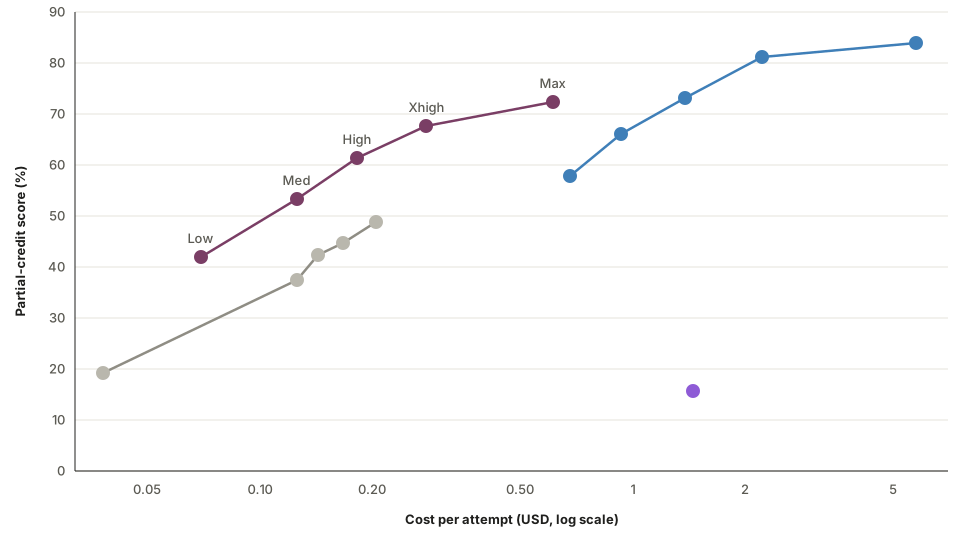
OSWorld 2.1 measures how well agents operate a real computer through long, multi-step tasks.
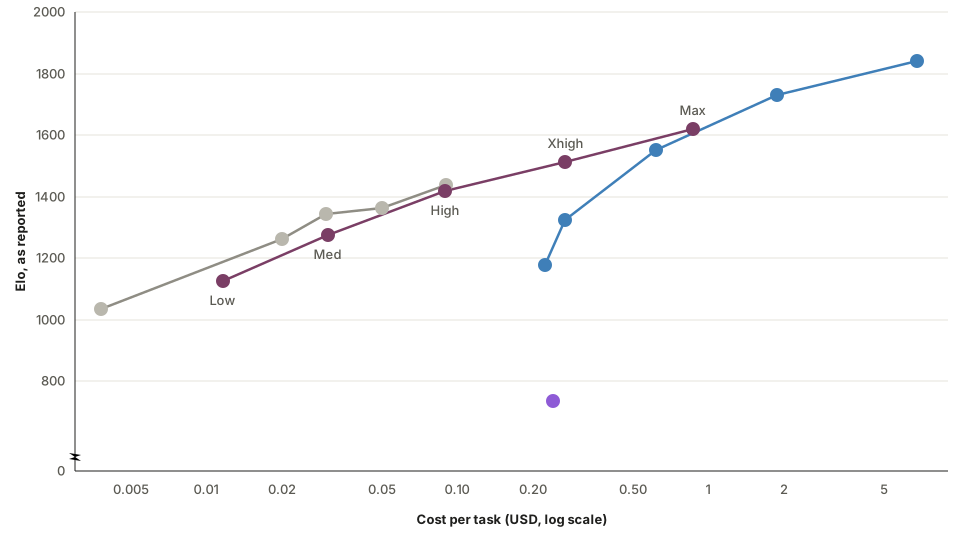
GDPval-AA v2.1 is run by Artificial Analysis. It tests agents on real professional work across 44 occupations. Haiku 5.5 reaches 1620 at Max, up from 735 for Haiku 4.5.
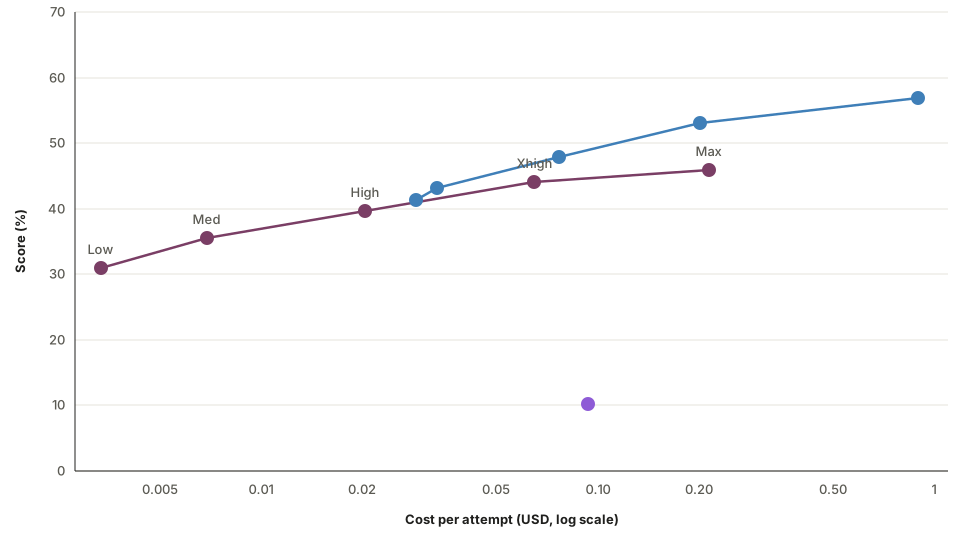
Humanity's Last Exam tests expert-level academic knowledge and reasoning. Haiku 5.5 scores 45.9% at Max without tools, compared with 10.2% for Haiku 4.5.
Early customer results
Anthropic says early testers saw results that match the numbers above.
- Asana ran its AI Teammates eval. Compared with the model it uses today, Haiku 5.5 cut task-completion latency by more than 30% and reached up to 2.5x faster inference per agent turn.
- HubSpot tested it on simulated CRM portals. Haiku 5.5 averaged 92.8% over three runs, the best score HubSpot has seen on that suite so far. It also finished a stale-record audit task fastest, with the highest hit rate and the lowest false positive rate of the models it tested.
- AlphaSense ran 400 queries through Ask in Document, a feature that handles about 8 million calls a week in production. Haiku 5.5 scored 0.84 against 0.76 for Haiku 4.5, a statistically significant gap.
- Box reported that in early testing, Haiku 5.5 scored 11 points higher than Haiku 4.5 at about half the latency.
- Cognition added Haiku 5.5 to the sidekick lineup in Devin Fusion. Paired with Opus 5.5 as the lead, Fusion holds a FrontierCode score of 66.2 while cutting cost and latency.
Pricing
Pricing is per million tokens. Requests up to 100,000 tokens made up about 90% of requests to the previous Haiku model, and that is where Haiku 5.5 saves the most.
| Price per 1 million tokens | Haiku 5.5 (up to 100k / over 100k) | Haiku 4.5 | Sonnet 5.5 |
|---|---|---|---|
| Cache reads | $0.01 / $0.05 | $0.10 | $0.10 |
| Cache writes | $0.125 / $0.625 | $1.25 | $2.50 |
| Input tokens | $0.10 / $0.50 | $1.00 | $2.00 |
| Output tokens | $0.50 / $2.50 | $5.00 | $10.00 |
Haiku 5.5 is priced 90% below Haiku 4.5 for prompts up to 100,000 tokens and 50% below for longer prompts. The average saving is around 75%. That figure also accounts for the new tokenizer, which is similar to the one in Sonnet 5.5 and Opus 5.5 and produces slightly more tokens per task.
Other pricing changes
Anthropic changed prices for its other models too. Sonnet 5.5 cache reads are now 50% cheaper, at $0.10 per million tokens instead of $0.20. On most agentic work, that cuts the cost of Sonnet 5.5 by about 20%. On Terminal-Bench 4.0, the chart below shows both cache price points.

Terminal-Bench 4.0 measures how well a model completes complex, multi-step professional tasks in a command-line interface. The chart also shows why Haiku 5.5 and the larger models serve different jobs. Sonnet 5.5 and Opus 5.5 handle complex agentic coding better, while Haiku 5.5 fits narrower tasks like compaction, summarization, and subagent work.
Max and Team subscribers also get a new monthly API credit. Max 5x users get $100 per month, Max 20x users get $200, and Team subscribers get up to $500 pooled across their users. The credits roll out this week and work with any model on the Claude Platform.
The Python and TypeScript Claude SDKs now support computer use and browser use in beta. Anthropic says Haiku 5.5 suits these tasks because of its speed, capability, and price.
Safety
Haiku 5.5 improves on Haiku 4.5 in almost every alignment evaluation. The model shows far fewer misaligned behaviors and is less willing to help with misuse.
Its cybersecurity safeguards are stricter than Haiku 4.5's but looser than the ones on Sonnet 5.5. They allow more defensive work, but they still block penetration testing and other techniques attackers are likely to use. Its biology safeguards match Sonnet 5, Sonnet 5.5, and Opus 5. Research biology questions are allowed, and requests judged likely to cause harm are restricted. Organizations with broader biology or cyber needs can apply to Anthropic's Life Sciences Verification Program and Cyber Verification Program.
Availability
Haiku 5.5 is available now on all major cloud platforms, including Amazon Web Services, Google Cloud, and Microsoft Azure. On the Claude Platform, the model ID is claude-haiku-5-5.
Try it on VEGA
Haiku 5.5 is the default model in VEGA's auto, chat, code, web, extreme, and memory modes. It fits quick answers, summaries, and lookups, where speed matters most.
For the hardest open-ended work, Opus 5.5 and Sonnet 5.5 remain the better choices, as Anthropic also says.
Read Anthropic's original announcement at anthropic.com/claude-haiku-5-5.