GLM-5.3: Frontier Coding with Emergent Cyber Capabilities

For GLM-5.3, scaling post-training is all we did. With GLM-5.2 we built the stack: IndexShare for efficient long-context processing, SAO for RL on long-horizon tasks, and slime for large-scale asynchronous training — all running on the long-horizon task environments we have been accumulating. Over the past month we kept scaling on this stack: more environments, more diverse tasks, and more compute spent training on them.
Today we are releasing GLM-5.3. It uses the same base model as GLM-5.2 — every gain comes from post-training. Compared with GLM-5.2, it is much better at complex coding and long-horizon tasks:
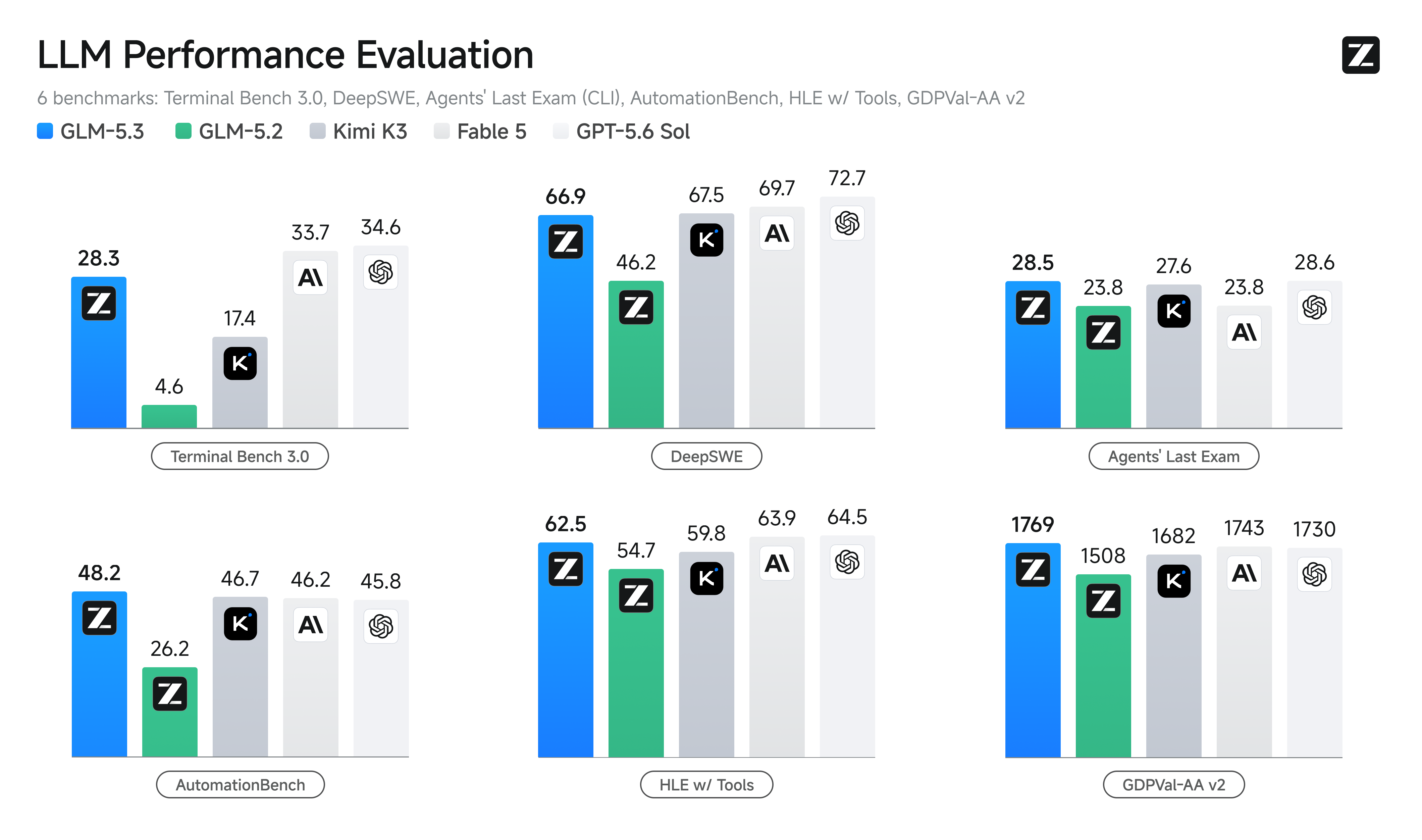
- Stronger Coding: GLM-5.3 is the most capable open-weights model for coding, with a 50% improvement over GLM-5.2 on our in-house Z.ai Code Bench. It also achieves open-source SOTA on public benchmarks including Terminal Bench 3.0 and Agents' Last Exam.
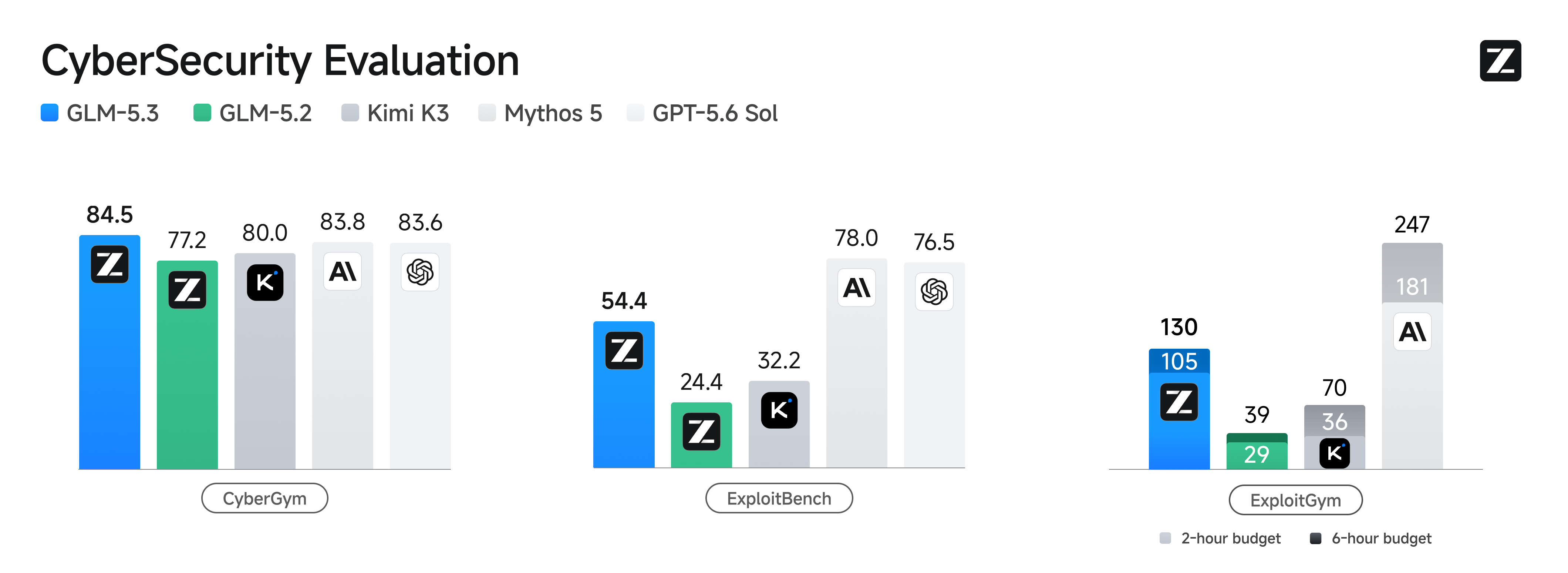
- Emergent Cyber Capability: As we scaled post-training, cyber capability developed faster than we expected. GLM-5.3 is state of the art on CyberGym for vulnerability discovery, and its gains are largest further up the exploitation chain, where it more than doubles GLM-5.2 on exploitation benchmarks.
- Open Source: We will release the weights in two weeks after launch, once safety evaluation and hardening are complete.
Emergent Cyber Capability
As part of post-training, we introduced vulnerability discovery data and environments into the training mix. We expected this to make the model better at finding and reasoning about vulnerabilities. What surprised us was how far the capability overshot that target.
We evaluate GLM-5.3 across three benchmarks covering different stages of vulnerability analysis and exploitation. On CyberGym, which starts from white-box source code and tests whether the model can identify and validate vulnerabilities by triggering faults, GLM-5.3 scores 84.5%, up from GLM-5.2's 77.2% — the best result on the benchmark, ahead of Mythos 5 (83.8%) and GPT-5.6 Sol (83.6%). On ExploitBench, which requires deeper reasoning about real vulnerabilities and their exploitation, GLM-5.3 reaches 54.4%, more than doubling GLM-5.2's 24.4%, while Mythos 5 and GPT-5.6 Sol score 78.0% and 76.5%, respectively. On ExploitGym, which measures how many exploitation tasks a model can complete under time-normalized budgets, GLM-5.3 completes 105 tasks within two hours and 130 within six hours, compared with 29 and 39 for GLM-5.2. Mythos 5 remains well ahead at 181 and 247 tasks. The pattern across the three is consistent: the further up the exploitation chain a benchmark sits, the larger the gain from GLM-5.2 — and also the wider the remaining gap to the closed frontier. Capability is growing fastest exactly where we are furthest behind.
We then tested whether these capabilities transfer beyond controlled benchmarks. Since GLM-5.2, we have been working with several security teams in China to run our models against real-world codebases. After expert review, screening, and deduplication, the model identified 2,436 vulnerabilities across 269 projects, including 1,097 medium-to-high severity issues. The findings span system kernels, operating systems, browser engines, open-source infrastructure, web applications, and network protocols. Many had remained unnoticed for years or even decades, with the oldest dating back roughly 40 years.
This work has since grown into an ongoing disclosure effort. We built the Z.ai Security Disclosure Ledger to maintain a public record of the findings as they move through the disclosure process. The ledger is continuously updated as new vulnerabilities are reviewed and disclosed, distinguishing issues that have already been made public from those that are still under disclosure. For disclosed issues, it records information including the affected project, severity, CVE where available, and how long the vulnerability had remained in the codebase.
slime: Built for Long-Horizon RL Scaling
All of this runs on slime, our open-source post-training framework for RL scaling, with Megatron on the training side and SGLang on the rollout side. Its design keeps training, rollout, and the data buffer on a single dataflow, so math, code, sandboxes, verifiers, and long-horizon agentic environments plug in as data generation rather than as changes to the training loop. That is what let us keep adding environments through GLM-5.2 and GLM-5.3 without rebuilding the training stack each time.
Through GLM-5.3 we kept building it out on two fronts. On the algorithmic side we added capabilities aimed at RL research: top-p mask, top-k and full-vocabulary OPD, and configurations that improve training–rollout consistency, including R3-style setups and full numerical alignment between the training and rollout paths, which give us finer control over sampling, training, and teacher signals, and make it fast to run controlled comparisons. In our training–rollout consistency evaluation, the average difference in log probabilities (logprob) was controlled at the 1e-7 level, representing a reduction of more than 99.99% compared with previous setups.
We also worked on resource efficiency and system throughput for large-scale RL. Local storage now serves as an additional caching layer, holding model states and data hierarchically that would otherwise sit in host memory. This matters most for multi-teacher OPD: with dynamic teacher switching and prefetching on the training side, several teachers can be used without standing up a dedicated long-running inference service for each, at limited added overhead and substantially lower resource consumption. For agentic and asynchronous workloads, we improved joint scheduling and load balancing between the router and slime, so that rollout requests with widely varying lengths and completion times make better use of inference resources. We added workload-aware heuristics that derive throughput-oriented configurations — prefill/decode resource ratio, concurrency settings, and other throughput-critical parameters — from the characteristics of each rollout environment. As a result, for long-horizon coding RL tasks, these system-level optimizations improved end-to-end RL training throughput by more than 2.3×, allowing us to scale training over longer trajectories and more complex environments with substantially higher efficiency.
Taken together, these give us more experimental flexibility, lower resource cost, and higher throughput — which is what makes it practical to keep scaling RL.
Getting started with GLM-5.3
API Changes in GLM-5.3
GLM-5.3 supports three thinking effort levels: low, high, and max. Disabling thinking is no longer supported by GLM-5.3.
| Parameter | Values | Default | Description |
|---|---|---|---|
| thinking.type | enabled | enabled | Enables thinking. disabled is no longer supported. |
| reasoning_effort | low, high, max | max | low: light; high: enhanced; max: deep. max is recommended for coding tasks. |
{
  "model": "glm-5.3",
  "thinking": { "type": "enabled" },
  "reasoning_effort": "max"
}
Migration required: If your application currently uses thinking.type: "disabled", change it to enabled and set reasoning_effort to low before updating the model ID to glm-5.3. Otherwise, the request will fail.
Use GLM-5.3 with GLM Coding Plan & ZCode
Try GLM-5.3 in your favorite coding agents — ZCode, Claude Code, OpenCode, and more. See the devpack overview.
For GLM Coding Plan subscribers: We've rolled out GLM-5.3 to all GLM Coding Plan users. The new GLM Coding Plan now uses a points-based quota system. Point usage is calculated separately for input, cached input, and output tokens. Model calls made outside peak hours consume 50% of the standard points. Peak hours are 14:00–18:00 (UTC+8), Monday through Friday; all other hours, including weekends, receive the 50% off-peak rate. Start building now: z.ai/subscribe
Get more from GLM-5.3 with ZCode
- 98%+ cache hit rate — repeated context billed at the lower cached rate, ~30% more effective tokens
- 1.5x limited-time quota boost — stack it with the cache savings for up to 180% your standard quota through August 31
- Long-horizon mastery — Goal mode plans, codes, tests, and verifies until the target is met
- Remote Control — monitor and steer long-running tasks from your phone via WeChat or Feishu
Try ZCode: zcode.z.ai
Serve GLM-5.3 Locally
The model weights of GLM-5.3 will be publicly available soon, within two weeks of launch.